
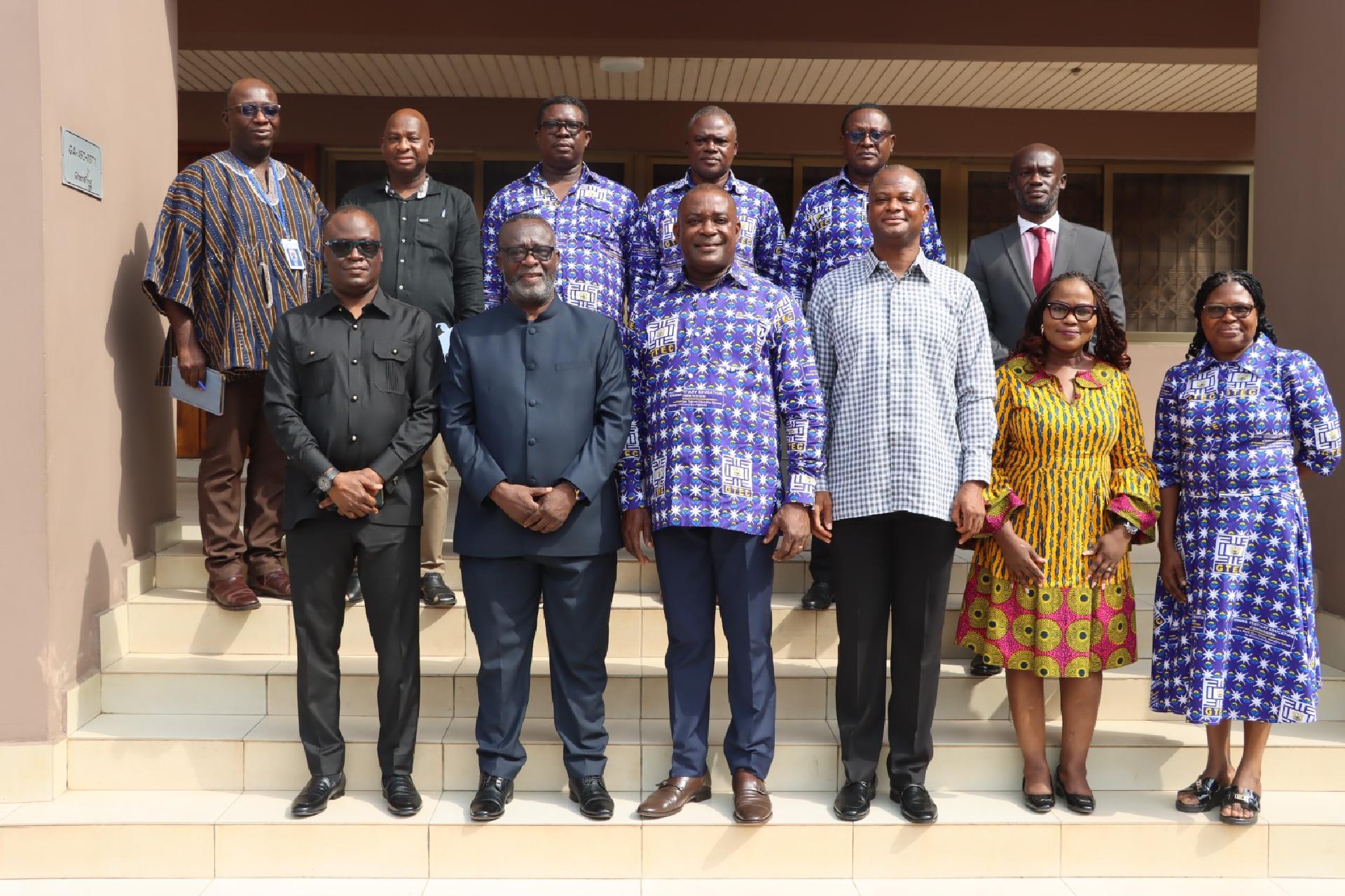
Accra, Friday, January 16, 2026 — The Chief Justice of the Republic of Ghana, His Lordship Justice Paul Baffoe-Bonnie, on Friday paid a courtesy call on the Director-General of the Ghana Tertiary Education Commission (GTEC) as part of efforts to strengthen collaboration between the judiciary and the national regulator of tertiary education in Ghana.
The high-level engagement, which took place at the GTEC premises, focused on two key national priorities: sanitizing the public space regarding the use of unearned academic titles, and advancing proposed reforms to Ghana’s legal education and regulatory framework currently before Parliament.
After the official welcome by the Director-General, Prof. Ahmed Jinapor Abdulai, the Chief Justice Baffoe-Bonnie opened the engagement by congratulating the Director-General and the Commission for what he described as the “highly commendable” work being undertaken to address the proliferation and misuse of academic titles such as “Doctor” and “Professor” in the public domain. He acknowledged that the abuse of such titles had become a nationwide concern and expressed his unflinching support for GTEC’s efforts to restore integrity and public confidence in the tertiary education system.
The Chief Justice noted that although the Director-General had offered to pay him a visit, he considered it important to personally come to GTEC to demonstrate mutual respect and to engage directly with an institution he expects to work closely with going forward.
As part of the second objective of the visit, the Chief Justice briefed the Commission on a draft bill currently under consideration by Parliament, which seeks to introduce a new regulatory framework for legal education and training in Ghana. He indicated that the reforms would require active support and collaboration of GTEC, given its statutory mandate to regulate and assure quality across the tertiary education sector.
He also addressed the ongoing public debate regarding whether Ghana’s law schools are overproducing graduates, clarifying that the judiciary does not share that view. According to him, the country needs more trained lawyers to meet national and institutional demands.

Welcoming a suggestion from the Director-General, the Chief Justice further agreed that GTEC’s regulatory role could be extended into the legal education space to ensure that individuals who present themselves as lawyers have indeed met all academic and professional qualification requirements. He added that, given the growing scope of GTEC’s work, the Commission itself may require a stronger in-house legal presence to support its regulatory and governance functions.
The Acting Director of the Ghana School of Law, Prof. Raymond Atuguba, provided a detailed overview of the proposed reforms outlined in the draft bill. He explained that the framework envisions the establishment of a Council for Legal Education and Training, which would assume responsibility for legal education functions currently performed by the General Legal Council (GLC), thereby allowing the GLC to focus more exclusively on regulating the legal profession.
Prof. Atuguba further stated that under the proposed structure, accreditation requirements, curriculum development, and academic standards for legal education would be jointly handled by GTEC and the GLC, ensuring alignment with national tertiary education standards and professional requirements.
He added that the Bachelor of Laws (LLB) programme would be restructured into two components: a theoretical academic phase and a professional training phase. Selected and accredited universities would be permitted to offer the Law Practice Training Course, which students would undertake immediately after completing the academic component of the LLB. Upon completion, candidates would sit for the National Bar Examinations before being called to the Bar.
Additional areas under review include faculty administration and staffing standards, institutional governance, and the introduction of uniform national provisions for academic and professional legal training.
In his response, the Director-General of GTEC, Prof. Ahmed Jinapor Abdulai, expressed his appreciation for what he described as a “powerful and distinguished delegation” from the legal fraternity. He reaffirmed the Commission’s commitment to supporting all institutions and bodies involved in tertiary and professional education, emphasizing that GTEC exists to facilitate quality assurance, accreditation, and regulatory compliance across the entire sector.
Prof. Abdulai assured the Chief Justice of GTEC’s full cooperation in advancing the proposed legal education reforms and working closely with the General Legal Council to position Ghana as a reputable hub for legal education in the sub-region and beyond.
He also requested indicative timelines for the parliamentary process, while acknowledging that such timelines remain subject to the legislative review and approval process.
The Chief Justice was accompanied by a distinguished delegation, including:
- Mr. Musah Ahmed, Judicial Secretary / Secretary, General Legal Council
- Prof. Raymond Atuguba, Acting Director, Ghana School of Law
- Mr. Sampson Yekple, Head of Protocol, Office of the Chief Justice
- Madam Jennifer K. Amoah, Secretary, Office of the Chief Justice
- Madam Deborah Ivy Lamptey, Secretary, Office of the Judicial Secretary
Senior Management of GTEC present at the meeting were:
- Mr. John Dadzie-Mensah, Director for Policy Planning and Research
- Mr. Saaka Sayuti, Director for Accreditation
- Mr. Jerry Sarfo, Director for Corporate Affairs
- Mrs. Anita Nanfuri, Director for Administration and Human Resources
- Mr. Maxwel Amoako-Kissi, Head of Credential Evaluation
- Mrs. Nancy Doe, Head of Internal Audit
- Mr. Felix Awuah, Head of Legal