
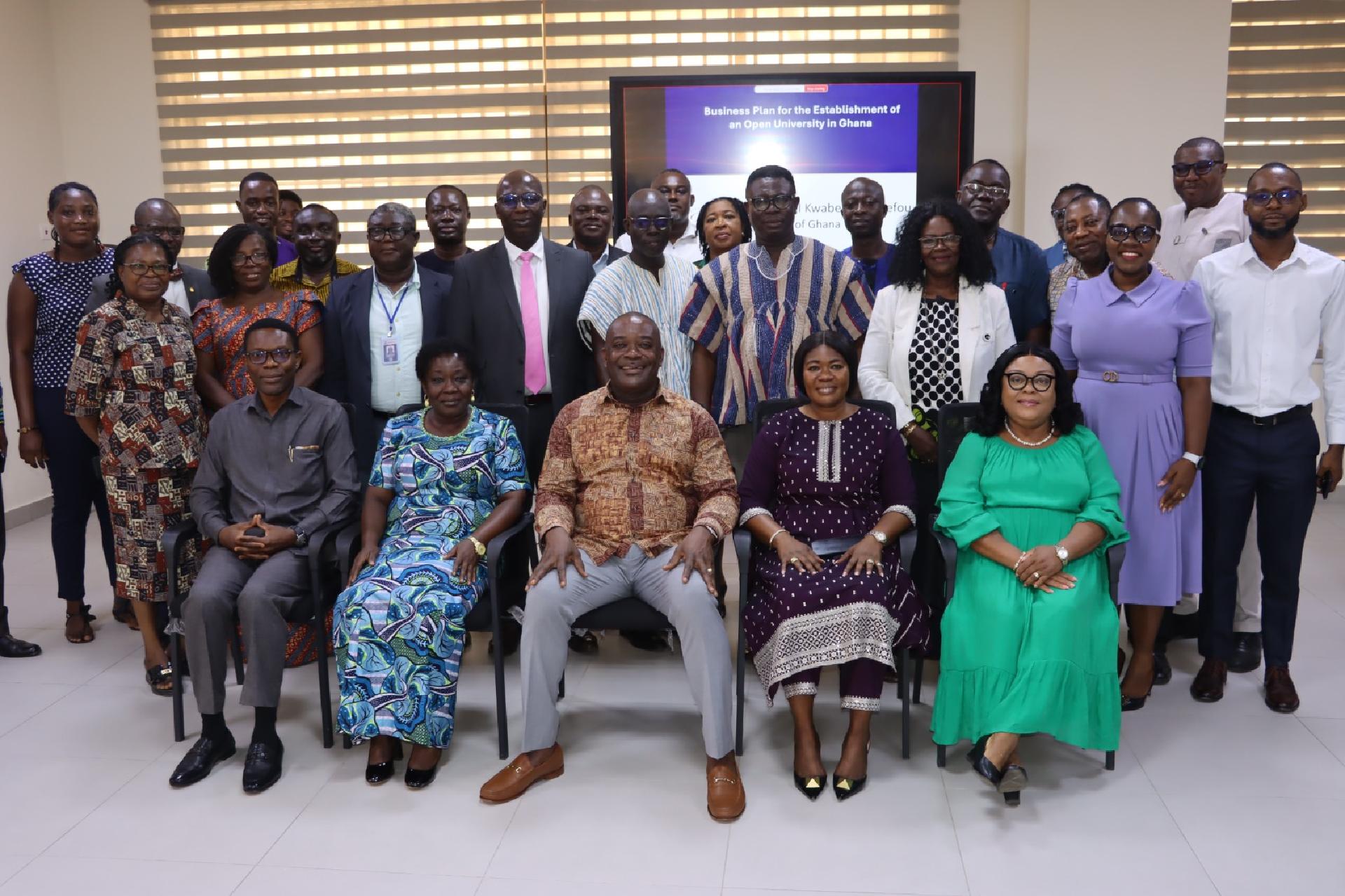
On Wednesday, 25 February 2026, the Ghana Tertiary Education Commission (GTEC), with support from the Commonwealth of Learning (CoL), convened a high-level stakeholder dialogue to shape the future of tertiary education in Ghana. At the heart of the discussions was the Draft Business Model for the proposed Ghana Open University (GOU); a bold, forward-looking intervention under Ghana’s Education Strategic Plan (ESP).

The Dialogue brought together key actors across the tertiary education landscape including public and private universities, distance learning institutions, regulatory bodies, and representatives from the Ministry of Education, all united by a shared vision: expanding equitable access to quality higher education for all.
The proposed Ghana Open University is designed as a flagship national institution to reach underserved, disadvantaged, and non-traditional learners including working adults, lifelong learners, and individuals in remote communities. Beyond widening access, the GOU is positioned as a strategic lever to help Ghana increase its tertiary Gross Enrolment Ratio (GER), strengthen human capital development, and drive economic transformation.
The initiative also aligns strongly with United Nations Sustainable Development Goal 4 (SDG 4), which calls for inclusive and equitable quality education and lifelong learning opportunities for all.

The Draft Business Model reflects lessons from previous open and distance learning initiatives, international best practice, and Ghana’s unique socio-economic realities. It outlines a sustainable institutional, governance, financing, and delivery framework aimed at achieving critical ESP targets while ensuring long-term viability.
But the Dialogue was not just about presenting a document; it was about refining a national vision. Through robust and constructive engagement, stakeholders identified key areas to strengthen the model, including:
- Integrating Recognition of Prior Learning (RPL) to value experience and informal learning.
- Acknowledging historical foundations within Ghana’s open and distance education space.
- Anchoring the University within a National Qualifications Framework.
- Clearly defining what “Open Learning” should mean in Ghana’s specific context.
- Prioritising STEM-focused programmes rather than replicating traditional university offerings.
- Distinguishing between ICT infrastructure and virtual learning delivery.
- Developing realistic, phased budgets to ensure sustainability.
- Avoiding the perception of the Open University as “free,” while maintaining affordability.
- Investing significantly in branding and public communication.
- Developing a detailed technical and operational plan to support implementation.
- Clearly showcasing what will differentiate the GOU from existing institutions, among other things.
The Dialogue marked an important milestone in building national consensus around the Ghana Open University. Participants affirmed that the success of the GOU will depend not only on sound policy and financing, but also on innovation, collaboration, and public trust.
As Ghana seeks to modernise its tertiary education ecosystem, the Ghana Open University is expected to embody a commitment to flexibility, inclusivity, and lifelong learning in a rapidly changing world.
The Director General of the Commission, Prof. Ahmed Jinapor Abdulai emphasized that GTEC remained committed to working with all stakeholders to refine the business model and translate this shared vision into a transformative national reality.